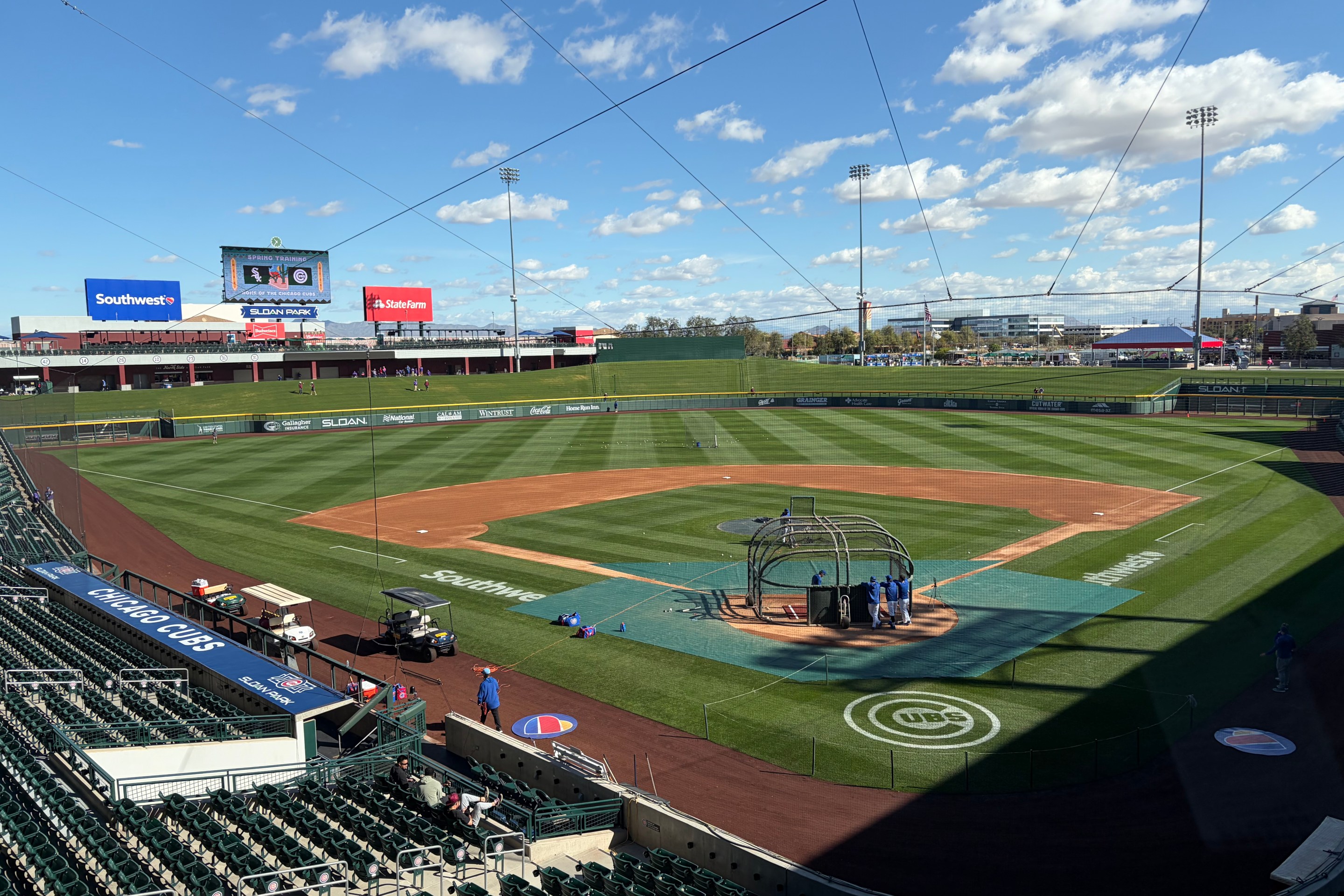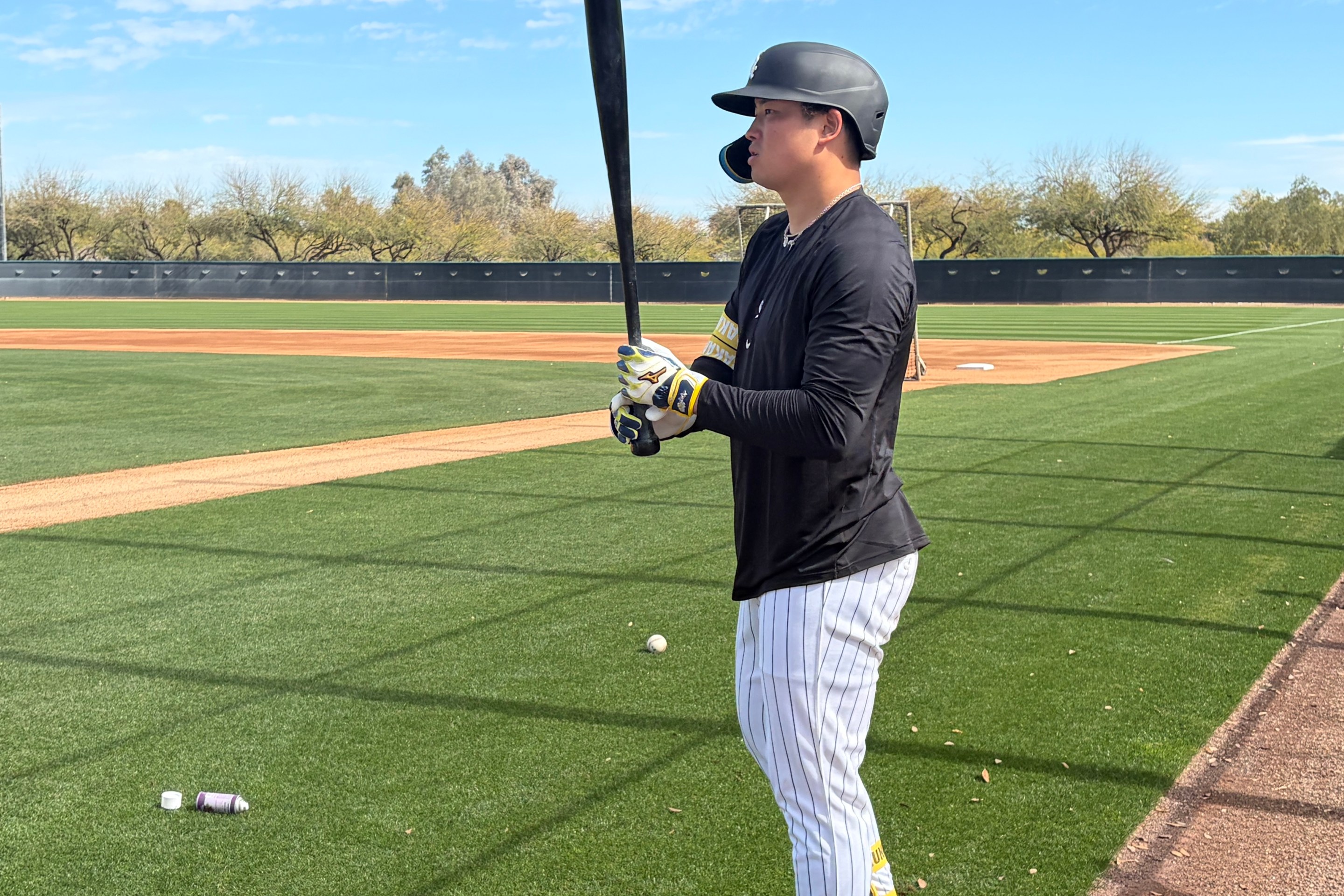
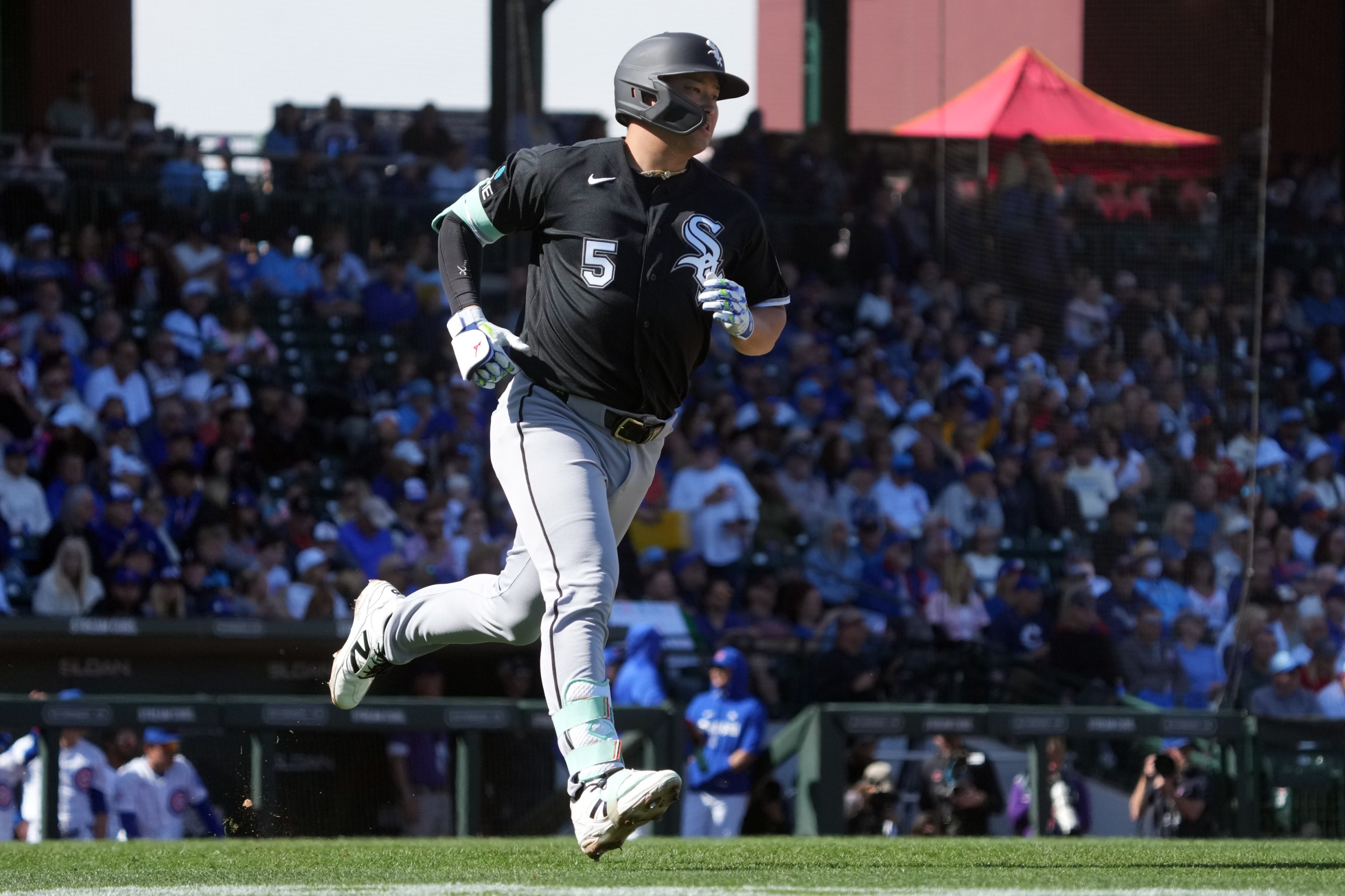
Munetaka Murakami's White Sox Cactus League debut on Friday almost wasn't one. His arrival to Sloan Park was delayed by a crash on I-10, and said that he was in the car until 12:50 p.m. for a 1:05 p.m. local start.
"Oh my god. Crash!" he explained in English, using his fists to illustrate.
He didn't get demerits for tardiness, perhaps because Will Venable was hung up in the same snarl, and when the dust settled, his line was one he'd take every day: 2-for-4 with a double and two RBIs, which offset a backwards K in his final trip.
Depending on your eagerness to parse a one-game sample, you might detect some signs of frazzle. He chased a fastball and two changeups into a groundout in his first trip to the plate, and then knocked down a potential 3-6-1 double play ball, instead settling for an assist on a 3-1 putout instead.
Then you could say he also settled in, as he came away with two hard-hit balls. He smacked a 108.3 mph single through a hole on the right side of second in the third, and then pasted a middle-middle 95 mph Porter Hodge fastball that short-hopped the center field wall for a two-run double. Granted, Seiya Suzuki would have caught it were he not overmatched by the dreaded high sky, but it would've been a well-earned sac fly in other settings.
Murakami was pleased with how it played out.
"It was a great at-bat. I was able to get good angles on the bat and velocity. I’m really happy how it went and how it went over my friend as well," he said, this time via interpreter.
Venable said that Murakami won't be in today's game, but he should be back in the lineup on Sunday.
⚙️⚙️⚙️
A standard MLB broadcast center field camera shows how much Sam Antonacci crowds the plate, and when Jameson Taillon tied him up with an 0-1 cutter in the second inning, I briefly thought, "Ah, there's the major league execution that will knock 100 points or so off his .439 career minor league OBP."
With Antonacci set up to respect the inside corner, Taillon tried to go outside with a four-seam fastball. If executed properly, it probably would've made home plate a few inches wider. Instead, Taillon left it over the inner half of the plate. Antonacci turned, burned and detonated it some 416 feet over the right field wall.
Antonacci hit just five homers over 519 minor league plate appearances over the course of the 2025 season, but he's hit four homers over 96 plate appearances as a Glendale-based White Sox employee when factoring in his successful 19-game Arizona Fall League experience last year. At 109.5 mph off the bat, it's a challenger for the hardest-hit ball of his professional career. Perhaps the unfamiliar violence coursing through his veins is why he punctuated it with a disproportionate bat flip and a couple of helmet slaps as he circled the bases.
Only he can say, because he stuck to platitudes about trying to get on base and win the game afterwards. That's probably for the best given his lack of status, although he's the perfect candidate to pimp homers and stand behind said pimping. What are they going to do, throw at him? That's threatening him with a good time.
⚙️⚙️⚙️
The box score shows the White Sox went 1-for-2 with their ABS challenges. See for yourself; there's a line for it and everything.
Kyle Teel's successful overturn of a called ball in the second inning demonstrated the challenge system's value. Teel had to reach across his body for a Jonathan Cannon sinker on the other side of the plate, making it look wilder than it was, and even then, home plate umpire Willie Traynor was barely incorrect about it. No egos were harmed in the filming of this episode.
That turned a 1-1 count into an 0-2 count against BJ Murray with runners on first and second with nobody out. Murray ended up grounding out to Murakami at first, and the White Sox ended up escaping the inning unscathed.
Drew Romo wasn't successful with his attempt to flip a call in the eighth inning, nor was he particularly close. He initially tried to hoist a low Zach Franklin slider back into the bottom of the zone, but Traynor called it a ball, and the challenge system proved Traynor correct with room to spare.
Egg on face aside, Romo might have indicated something about the team's strategical mindset. At that point, the White Sox had their two challenges remaining with two innings to play and a six-run lead. If correct, he would've had Franklin one strike away from closing out the eighth. What were the chances of Romo or the White Sox having two higher-leverage calls over the remainder of the game? Incredibly unlikely, so it made sense to let it fly.
It'll be fun to see which metrics emerge to reflect challenging value, especially for catchers. A straight percentage won't tell you everything, because if every wrong call is treated the same, that'd dissuade catchers from this sort of justified Hail Mary challenge, the way NBA players wait until the buzzer goes off to heave a 55-footer so it doesn't harm their shooting stats.
Given that Tom Tango has already developed a run value system for challenges based on counts and baserunners, it'll probably be fairly easy to develop a Win Probability Added or Leverage Index stat to give proper weight to challenges that accept some real risk for the potential of a real reward.
⚙️⚙️⚙️
Eight White Sox pitchers combined for a strong team line, especially for a Cactus League debut: 9 IP, 7 H, 1 R, 1 ER, 4 BB, 12 K, 1 HR.
Jonathan Cannon had the hardest time, allowing two hits, a walk and a hit batter over 1 ⅔ innings. It only amounted to one run, but that came from a Suzuki solo shot off a sinker, so that's not what he had in mind for the return to the two-seam version. It's a long season, and given that it's a World Baseball Classic year, it's also a long spring.
Tyler Schweitzer gave up three hard-hit balls over two innings, including a pair of high fastballs that righties foiled into opposite-field singles, but his changeup got a couple of goofy swings when he was able to get to it.
Half of Jairo Iriarte's 10 fastballs were 95 mph or higher during his scoreless sixth inning, which is the kind of velocity he couldn't access with regularity last year. Now that he's off the 40-man roster, he'll have to find a lot more of it in order to regain the ground he's lost. But one game in, it's a start.