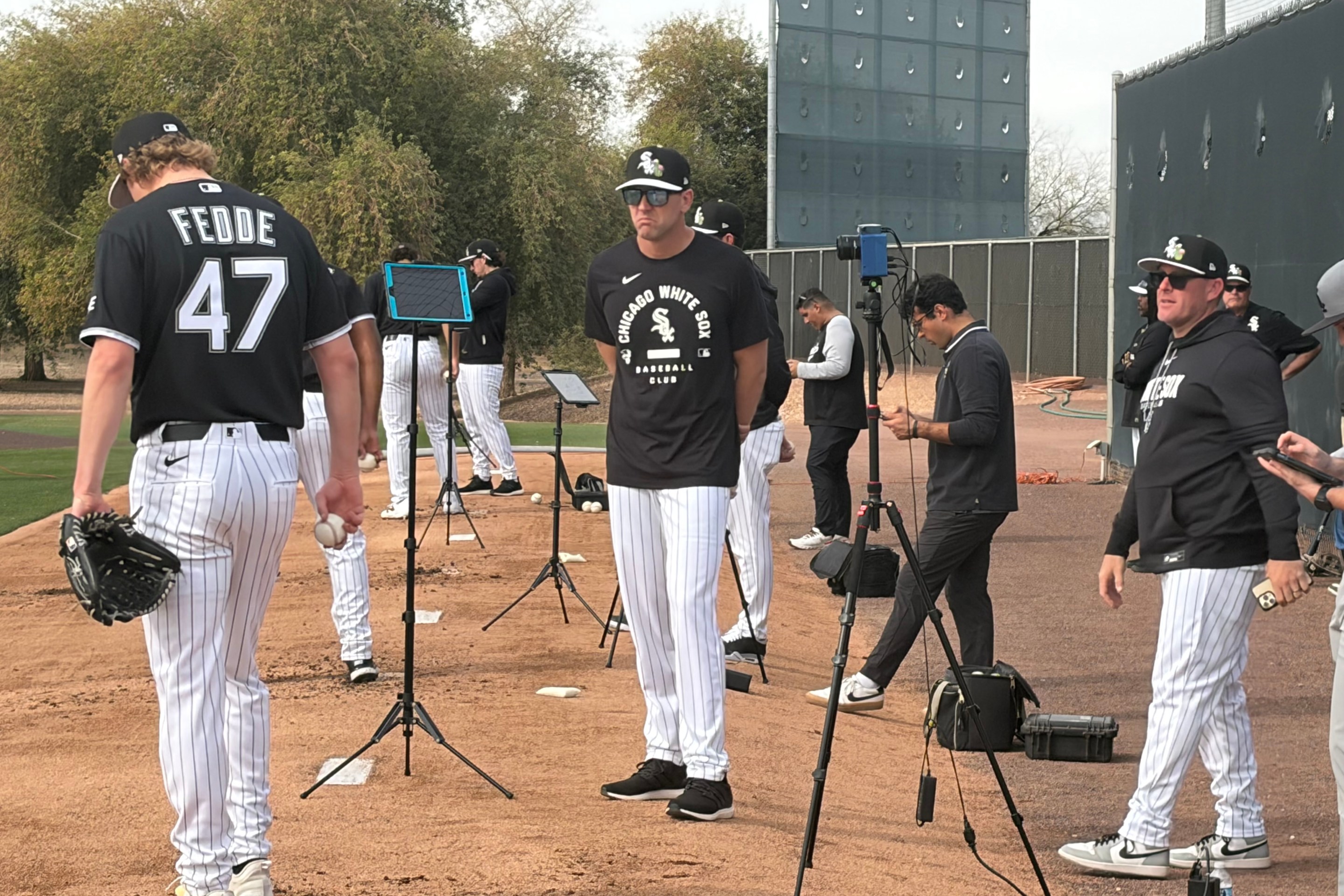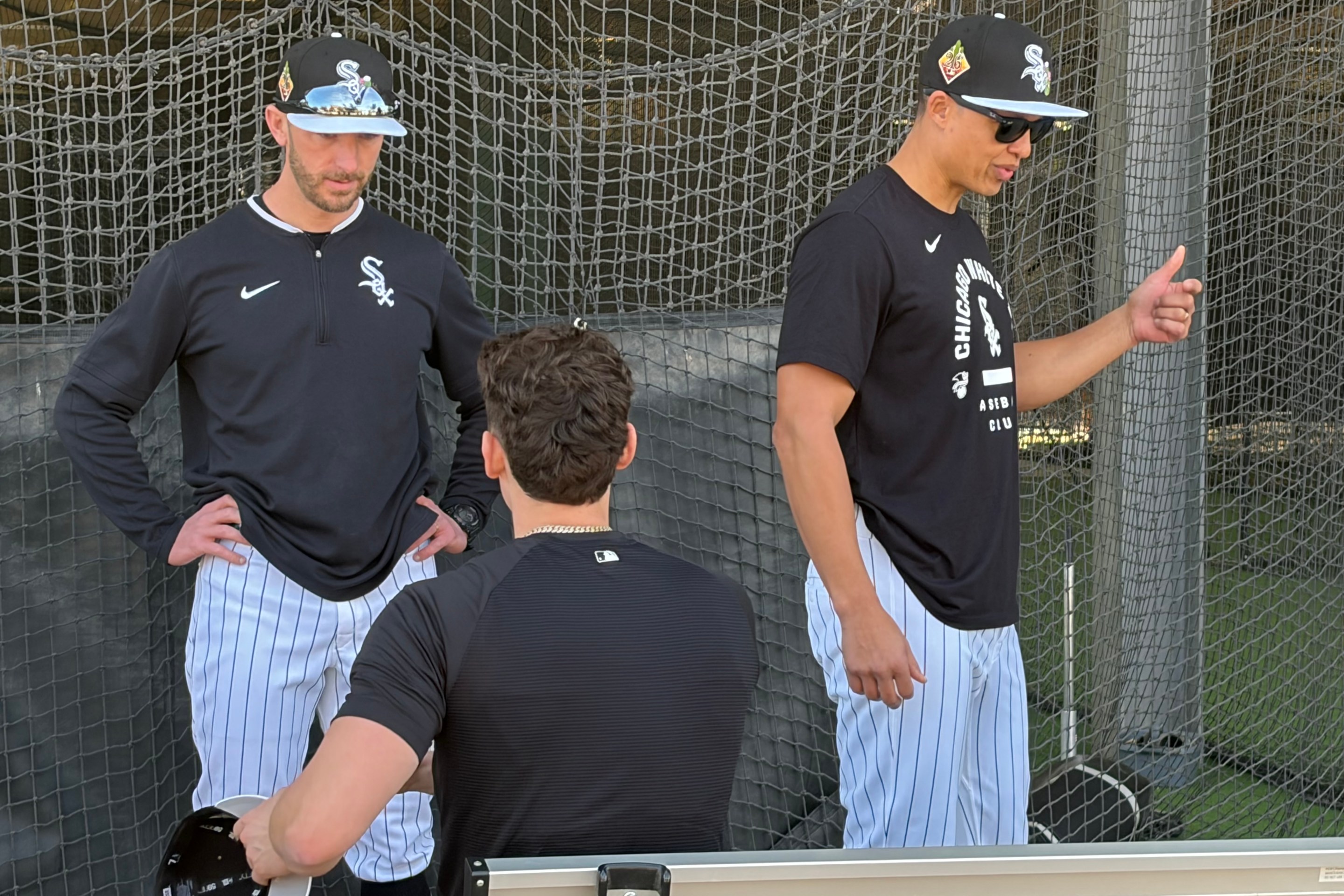

If you know just one player on the 2026 White Sox, there's a very good chance it's famed slugger Munetaka Murakami, since early media coverage from his native country shows there is a healthy audience for video of him walking around, and Chris Getz had to address the issue of his misspelled locker nameplate at his Monday afternoon presser opening spring camp.
But if you know two, one of them must be Colson Montgomery. Last year's SoxFest Live weekend also centered the second year shortstop as the biggest current star, also saw him draw the largest cheers at opening ceremonies, and also had team executives hyping his future and how central he'll be to the next contending Sox teams. Much like the cheers, it all resonates significantly more after Montgomery whacked 21 homers in 71 big league games last year, making it easier to see him as a building block for a winning team than it was this time last year, let alone last April.
"It's definitely given me confidence on what I can do, my capabilities," Montgomery said at SoxFest. "I feel less pressure. The past two spring trainings, my mindset was trying to break with the team. This year I know I'm going to Chicago."
It's a good opportunity for Getz to tout that he was simply right the whole time about Montgomery's long-term outcome, since his old quotes reveal he certainly can't be accused of being a fair-weather fan. Or better yet, that scouting director Mike Shirley was always right, since he'll be wielding an enormous draft pool in five months.
"It was just product of the organization and the coaches believing in me," Montgomery said of his 2025 campaign. "Their belief in me from the start is kind of what kept my confidence and my belief in myself. I had belief in myself, but if you are struggling and the organization is still high on you, and still believing in you, it give you extra motivation."
But a more immediate thing to credit Getz's operation with is not being afraid to intervene -- be it the Arizona overhaul or coordinating Zoom sessions with Montgomery's private hitting coaches -- to restore the trajectory of a player whom evaluators across the industry were beginning to downplay how much they ever believed in. Making players better than their acquisition cost has to become the White Sox's bread and butter to transcend a bottom-end payroll, and they also need to keep making Montgomery better.
Sure, he's already produced more bWAR (3.3) than the club's 2017 and 2019 draft classes combined, but part of both respecting his talent and the depths of struggle he pulled himself out of is accepting that the guy who struck out in 38 percent of his Triple-A trips to the plate last April is not a finished product. Montgomery himself has certainly already been shown the data behind it.
"I was with [hitting director Ryan] Fuller and some of our hitting coaches and we just went over the season," Montgomery said. "The good and ... not the bad, but just more things you need to maintain and continue to get better, because this game, from five, 10 years ago, this game is already totally different. You've just got to be able to adjust and keep getting better. It's just being aware of what I need to get myself out of if I'm feeling a certain way; that's drills, mindset or anything."
Montgomery struck out 29.2 percent of the time in his rookie campaign, with a sub-70 percent overall contact rate. Both figures that would suggest -- despite how productive he is when he makes contact (.290 ISO) -- that he's living on the borders of viability, certainly for someone expected to be a centerpiece of a major league offense. It's a below-average in-zone contact rate (82 percent), which lends a note of truth to scouts who knocked his barrel precision when Montgomery was at his lowest. But with all praise due to the torpedo bat, it's also not an abnormal figure for a high-ended power hitter, nor nearly as bad as even mid-2024 scouting looks would have suggested. Byron Buxton posted the exact same figure last year, Cal Raleigh and Shohei Ohtani posted worse, and no one's questioning whether they cover the zone well enough to access their raw pop.
The weak point of his Montgomery's rookie offensive profile is more of an unexpected one. He chased pitches out of the zone at a rate over 30 percent. For anyone that remembers the most exciting part of Montgomery's low-minors performance being the sky-high walk rates, or just knows that he chased at a sub-20 percent rate in 2023, it's a surprising development. Or an encouraging one, since he merely needs to improve at something he's looked great at in the past. It would also serve to explain why Montgomery spends so much time lauding the benefits of the Trajekt machine in building out the plate approach he'll hone to continue producing ridiculous power numbers.
"We put together a heat map, because pitchers have a heat map on you," said Montgomery, discussing a strategy session with White Sox coaches. "They're going to do this to you, so what do I want to do? I want to swing here, and I'm going to be OK with this. Or I'm going to swing here and I'm going to be OK with chasing--like, I have to pick. Am I going to chase up or down? Or am I going to chase out? We did all that stuff and we came to the conclusion that my biggest thing is ... well, I don't want to give out a scouting reports on myself, but I'm just thinking out over the plate and reacting."
And the larger purpose of Montgomery using machine reps and cross-referencing it with data on where his swings do and don't have success, is to boil down his approach to a series of reactions. Much like a seasoned blackjack player already know if they're hitting, staying, splitting, etc. in a given situation before it arises, Montgomery wants to progress toward knowing what his decision is if he sees a certain pitch shape in a certain quadrant. It's just that interstitial notes of progress might not look like more patience or less chasing, at least not right away.
"The times when I used the Trajekt a lot when there was a game that day, I was jumping on first pitches more because I was more comfortable, because I saw what he looked like already," Montgomery said. "I will have [the simulated opposing pitchers] throw strikes, and then I'll have him throw balls so I can differentiate. Then I'll swing at a ball and think, 'Oh, I handled that pretty well.' So if I do chase, that's as far as it needs to be. I don't want to chase, it happens. But I've hit some balls hard that are off the plate.
"It just helps with your overall zone. Because you can't try and say, 'I'm going to cover the whole strike zone.' It's too hard. So you create your own zone. You say this is where I'm going to be and I'm going to be OK with them hitting these spots."
It's fitting that Montgomery has similar contact metrics to Buxton, a hitter whose power-over-hit orientation could look discombobulated in short stints made disparate by his repeated injuries, and who had to fend off notions that moving him off a demanding, premium defensive position would give his bat more room to breathe. After posting downright gaudy DRS (+7) and OAA (+6) metrics at short last year, Billy Carlson and Roch Cholowsky seem like the biggest threats to Montgomery sticking there than anything else. He's also still 6-foot-5, 230 pounds and significantly larger than the typical big league shortstop, and has dealt with back and oblique issues at multiple intervals in his career.
But even if Montgomery's 108.2 mph 90th-percentile exit velocities piled up more value than his glove, the latter provides the former with the runway to mature into a star-level weapon. From his view, Montgomery has manned 254 games in the field (including the minors and the Arizona Fall League) since the start of 2024, after injuries robbed him of half the 2023 season. And the residue of intentionally putting Montgomery in a locker room with Mike Tauchman and Michael A. Taylor and having him watch the aches and pains veterans play through up close, is he thinks his biggest source of development will not be working on the Trajekt machine in the hitting lab, but being out on the field.
"If I put my mind to saying, 'Yes, I'm hurting, but get through this game,' it helps me get through the game and I'll worry about tomorrow, tomorrow," Montgomery said. "I've just been carrying myself mentally to play 162."