The White Sox originally hoped for a world where top lefty pitching prospects Noah Schultz and Hagen Smith pushed to make their major league debuts in 2025, and both cleared the 100-inning threshold for the first time in their lives.
Instead, both missed time due to injury. After some elbow soreness earlier in the year, two postseason starts and an encouraging stint in the Arizona Fall League nearly got Smith to triple digits, but fell a little short at 98⅔. Schultz wasn't able to take on the extra work, as the White Sox shut him down due to patellar tendinitis after 73 innings at the end of August. The experience of this year might ward the Sox off from assuming anything, but their same ambitions will just carry over to the new season.
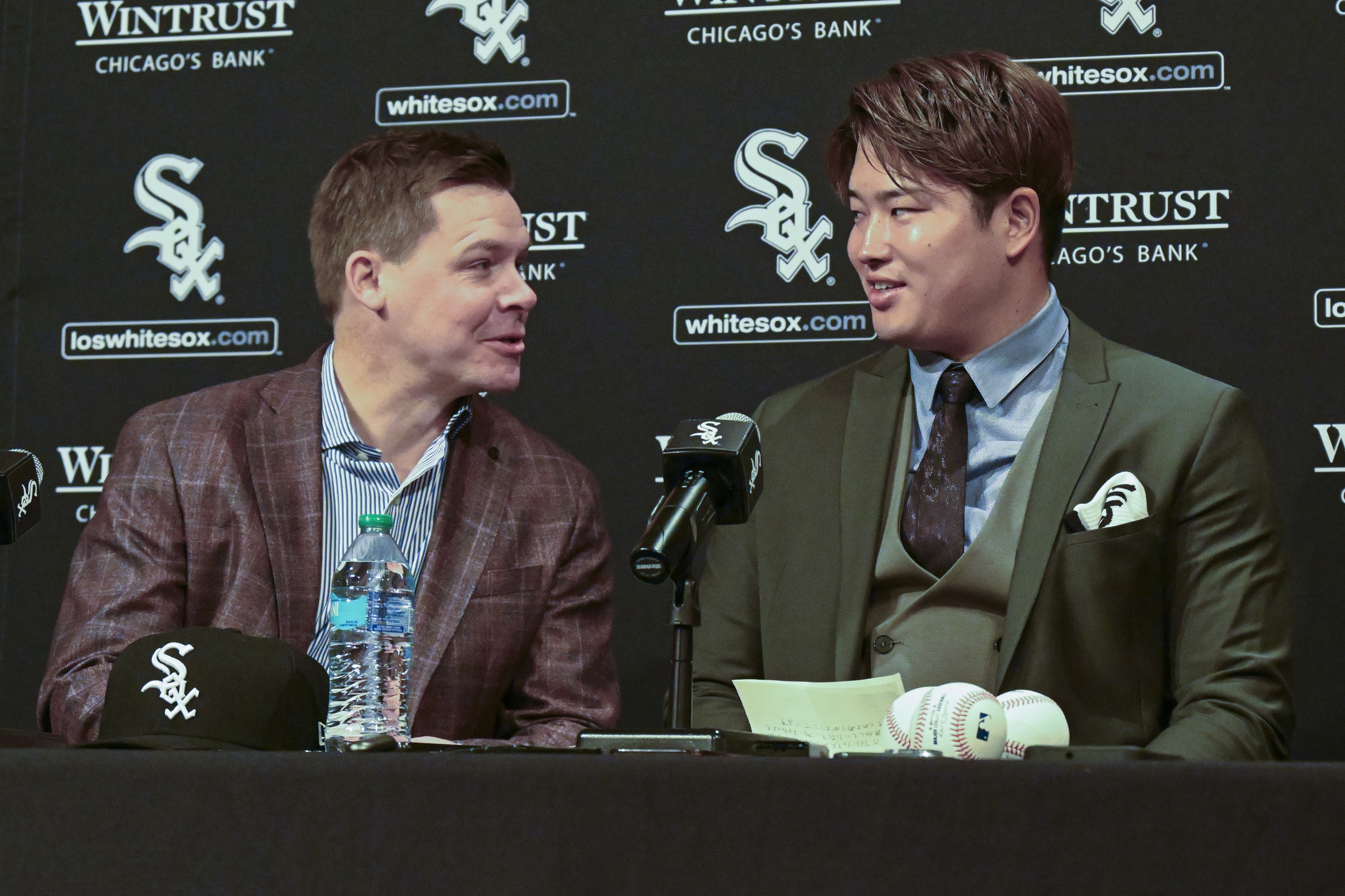
"I don't want anyone to get ahead of themselves," said Chris Getz. "Most importantly the players, I want them to just have a dominant offseason, taking care of their bodies, going through a proper throwing program. Once you get to spring training and baseball action really picks up, you get a real idea of where these players and pitchers are. Both of those players, I could see them getting into the fold next season at some point."
While the low inning totals and health scares would normally suggest a still-limited workload for 2026, Shane Smith shouldering a 52-inning increase in 2025 without any arm issues lends credence to a more flexible approach being viable. Specifically, the Sox believe the progress they've made in tracking biomechanical indicators, the physical assessments they take including grip strength, allow them to monitor and detect signs of fatigue and wear rather than simply setting an innings target and hoping nothing goes wrong.
That doesn't mean there's some scenario where Schultz or Smith throws 180 innings next year, but there more room for them to prove their way to contributing throughout the length of season than their '25 numbers might indicate. Additionally, while some have speculated about the scenario where Schultz and Smith are added to the 40-man roster in '26 and thus barred from pitching in the minors if a lockout delays or cancels the 2027 season, the Sox initially don't sound inclined to stall their development for the sake of avoiding such a situation.
⚙️⚙️⚙️
By 2027, the White Sox should have their new minor league academy up and running in the Dominican Republic, with still some hope of holding an instructional league for prospects housed there by next fall, even if that would require the sort of smooth timelines that significant construction projects don't usually enjoy.
The White Sox are still expecting to be able to field two DSL teams once the facility is up and running, which is aimed at addressing the player development side of the franchise's struggles to matriculate IFA talent to the majors. On top of the recent spate of pre-signing agreements with seven-figure Dominican talents that have leaked out, the White Sox have been sending quasi-development plans out to the buscones (trainers) managing said players, in an effort to better manage the intervening years before they officially join the organization.
Team officials have repeatedly assured that the team's investment in education, cultural acclimation and language instruction for Latin American players wasn't diminishing after the surprising decision not to renew minor league education coordinator Erin Santana after eight years, as she was spoken highly of in the organization both before and after her departure. To that end, a significant hire was recently made and is expected to become official later this offseason.
⚙️⚙️⚙️
As of the final week of the season, the White Sox now have Hawk-Eye tracking technology installed at their three-highest affiliates, though they are not expecting to have it at Low-A Kannapolis next season. It's not on the backfields of the team's Arizona complex either for ACL or bridge league action, but that is mitigated by the presence of the pitching and hitting labs.
Having biomechanical data for analysts to parse through for early signs of mechanical variance, performance slippage, or monitoring for indicators of fatigue or potential for injury, is the bedrock for a lot of their perceived developmental improvement, which takes on a greater importance for an organization that needs its young players to produce during their contractually inexpensive years.
The Birmingham Barons' back-to-back Southern League championship seasons are often cited as valuable for exposing players to the necessities of winning baseball. But it's the Barons' style of play, with their reliance on defense and situational offensive execution that the Sox hope to produce position players who can better hold their own fundamentally upon arrival to the majors.
There's a variety of reasons the Barons' success hasn't translated to the Triple-A Charlotte Knights, but as far as environment, many in White Sox player development believe the transition from the minor league baseball to the major league ball, which often diminishes inverted vertical break, can be as big of a factor as Truist Field's small dimensions. For different carrying traits, the Sox have recently had Grant Taylor (great stuff) and Drew Thorpe (great control) bypass Charlotte entirely, but profess not to have a larger intention to have their pitching prospects duck it going forward. The different ball and smaller parks are both issues that pitchers will simply have to deal with eventually anyway.
Despite some of the issues with heat exhaustion experienced across the Phoenix valley this past summer for teams having their recent draft picks, rehabbing minor leaguers and international signings playing in the bridge league through August, the Sox aren't anticipating any changes to the league's structure to avoid the weather beyond something basic, like earlier start times.
⚙️⚙️⚙️
Will Venable is possibly a good deal higher on using openers than even his initial year's usage reveals. While it's something young White Sox starters might be wise to get used to, the demands of controlling reliever workloads in the minors makes it unlikely to see the strategy being modeled at the affiliates.
The Marlins raised eyebrows across the league this year when they began having coaches call pitches in the dugout, taking control away from their catchers, but also modeling a policy that had already been in place at their minor league affiliates.
It struck many across the league as something that could become commonplace in the near future, as statistical model-based pitch calling could gain steam as a more efficiently-performing, if dehumanizing method. It doesn't sound like it'll be in the works for the Sox this coming season, but it's something teams will be talking about.
⚙️⚙️⚙️
The organization is very high on Caleb Bonemer, who vaulted himself into top-100 prospect territory by winning Carolina League Player of the Year in a season he largely played as a 19-year-old. If he can repeat his 2025 performance, a combined .281/.401/.473 batting line in 107 games, Bonemer will be in line for a 2027 debut. He's expected to mix between shortstop and third base next season, where he played after being promoted to Winston-Salem while recent third-round pick Kyle Lodise manned short. But given the trajectory of his bat, Bonemer playing the outfield -- likely left field -- is a potential long-term consideration as a means of getting him into a lineup where Colson Montgomery has staked a claim to the left side of the infield, and Billy Carlson's revered glove looms behind.
Already a utilityman and expected to push for a major league debut next season, Sam Antonacci in left field is also something the team would consider at some point.
-- Aldrin Batista was quietly a favorite of rival scouts on the backfields during this past spring, but a stress fracture of his pitching elbow made 2025 into sort of a lost season for the 22-year-old Dominican right-hander, who was limited to 15⅔ innings between High-A and LIDOM. He'll slot into the Double-A rotation next season, but Batista will be Rule 5 eligible next winter and the Sox are aware that his compressed timeline might necessitate a move to the bullpen to make him ready for a 40-man roster placement.
Batista is a lean 6'2" low-slot right-hander who previously won the organization's strength and conditioning award for pitchers, and has worked his sinker into the mid-90s. He recorded a combined 2.93 ERA with 116 strikeouts and 39 walks in 110⅔ innings across Low and High-A in 2024.
-- Tightly-wound, little Javier Mogollón is expected to be a full-go for spring training after a recurrence of hamstring strains limited him to a .220/.347/.387 in 51 games at Kannapolis. Mogollón only recently turned 20 and true to his nature, pushing himself on the basepaths even while his hamstring wasn't quite 100 percent is believed to be the cause of the recurrence.
Alexander Albertus, the most troubled piece of the Erick Fedde trade return, does not have that level of certainty. He was still feeling discomfort in his surgically repaired left tibia at the end of the year, and the Sox sent him home to rest and recover. He'll next try to ramp up activity when he reports to the complex in January.