We've barely started 2026 and I've already listened to a New Year's resolution from a friend that sounded less like a targeted, specific lane of self-improvement and more like altering a fundamental tenet of their existence on Earth. Let's direct that same kind of energy to the baseball team this site focuses on.
Normally, this is what the first two weeks of spring training interviews are for, but it's still January. So instead, let's parse some sourced Trackman data and pick out the one thing some key players need to harp on in order to become exactly what the White Sox need in 2026*.
*This is, 98 percent of the time, not how player development works.
Colson Montgomery - 44 percent chase rate on breaking balls
For someone whose last two seasons have been so heavily characterized by exploding strikeout rates and scouts chiming up about how they always doubted his hit tool, part of the surprise of Montgomery's midseason charge toward pulling in Rookie of the Year votes was seeing him make close to an average amount of in-zone contact in his debut season, especially after switching up the weighting of his bat (i.e. the torpedo bat) took some of the length out of his swing path.
He's still decently far away from an average hit tool, and his 29.2 strikeout rate wasn't an accident. But Montgomery hitting for enough power to make a high-strikeout profile work is a lot easier to envision when he isn't defanged by pitches above the belt. Instead, his problems seem more within his control now: Montgomery whiffs most of the time when he chases, and he chased too much in his debut season. Drilling down further into it, he mostly acutely struggled with spin, where his above listed figure greatly outpaces the 30 percent league average chase rate on breaking balls.
Luis Robert Jr. is still on the team and still a great example of why "chase fewer sliders, please" isn't the most useful advice. What separates Montgomery's recent struggles is that before he started flashing elite power (108.2 mph 90th percentile exit velocity last year), plate discipline looked like his best skill. By the same measure that had him at a 30 percent overall chase rate in the majors last year, it was only 26 percent at Triple-A Charlotte in 2024, and 17 percent at Double-A Birmingham in 2023. His body is bigger and stiffer, and the breaking balls are harder and sharper than those days, but this is a soon-to-be 24-year-old who believes in the value of pitching machine reps, has expressed a lot of confidence in his ability to recognize spin and shown it on the field in the past. It reads as an area where he can still improve.
Munetaka Murakami - 73 percent in-zone contact rate
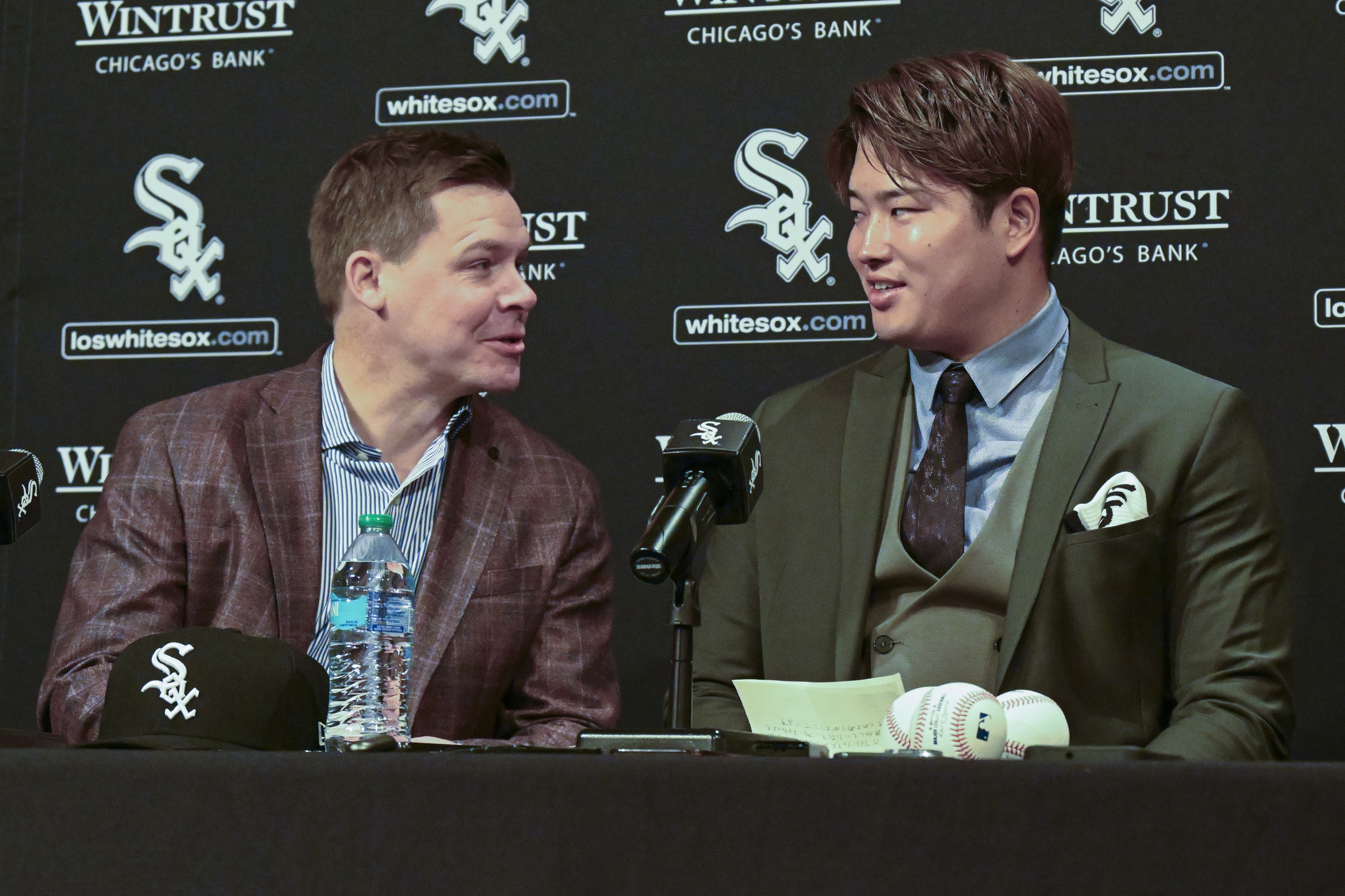
There's not a ton to add to a topic that I'm fairly sure has been discussed here before, and Murakami himself has certainly been made aware of the issue once or twice since his posting window from the Yakult Swallows first opened. Rafael Devers' 73.8 percent mark represented the only MLB hitter with an in-zone contact rate in Murakami's neighborhood in 2025, and Devers has both demonstrated that his style can work, and also done it against better pitching.
What's notable is that Murakami's in-zone rate has been as high as 81 percent as recently as the 2021 season in NPB. Granted, that came the season before his breakout 56-homer campaign (he hit a mere 39 in 2021), but it grants some credence to the theory that there's some latent ability to make more contact in Murakami's swing, and that the past few years of being one of the most productive sluggers in his country's history has just not compelled him to make that sort of adjustment.
Chase Meidroth - 13.5 percent first-pitch swing rate
Suggesting any tweak to Meidroth's style feels sacrilegious, since the relentless nature of his game deserves so much credit for his big league career. But part of the pesky nature of his at-bats (4.07 pitches per plate appearance) is running deep counts. It tires opposing pitchers out, but also means a lot of two-strike situations, and Meidroth's already-low 14.3 percent strikeout rate undersells how good he is at making contact because his back is against the wall so often.
His 40 percent chase rate in two-strike situations (38 is league average) also undersells how good his batting eye is, but he's also pretty good at fending off pitches outside the zone, and taking away from his battling nature in those situations feels like a failure to appreciate who he is as a player.
Instead, there seems like there's room to spread a little of his aggro around. The average MLB hitter is first-pitch hunting close to a third of the time, and while the average hitter is also a bigger power threat than Meidroth, there's a lot of daylight here for him to show pitchers who would try to groove their way to a two-strike count against him that they need to be more cautious.
Sean Burke - 5 IVB, -5.4 HB on slider
Pitchers are trickier for this already facile exercise, because looking at Trackman numbers and suggesting that they throw their best pitch more often --without context -- is an easy way to be very stupid and annoying. So this is cheating because Burke has already discussed this, but he discovered late in 2025 that all his catch play practicing a new sinker was the likely culprit in the movement for his slider changing and performing worse.
If those two numbers above about his slider look meaningless without more context, Burke's slider registered at 3.3 IVB (induced vertical break, which means it had more vertical drop) and -4.1 HB (horizontal break, so there was less sweep) in his dynamite 2024 big league cameo. Even if the league was always going to adjust to Burke to some degree, the difference in results (26 percent miss rate in '25, 35 percent in '24) is stark enough to provide some real incentive to get his old slider shape yet. It was something he was working on by the end of last year, in the sense that he's stopped practicing his sinker in catch play, and will be an immediate thing to watch as he tries to cinch up a rotation spot this spring.
Jonathan Cannon - 94 percent in-zone contact rate on sinker
Cannon is not a bat-missing pitcher and to the extent that he is, his sinker has never been a bat-missing pitch. But when someone is already living on the fringes of the contact level that MLB pitchers can succeed with, an offering as oft-used as his sinker losing five percentage points of whiff from his rookie season (89 percent in-zone contact in 2024) carries some real sting.
Accordingly, by the end of the year when Cannon returned to Chicago -- but not to his rotation slot -- he had already begun making the switch from a one-seam sinker grip back to a traditional two-seamer. When he arrives in Arizona in February, Cannon will be trying to throw the two-seamer he relied on as a prospect pre-2024, with the sweeper and seam-effects changeup that Brian Bannister taught him that spring.
Grant Taylor - 38.7 percent zone percentage for slider
Taylor's slider has regularly racked up awesome results in limited usage, and 2025 was no different. Opponents had a .088 wOBA against it in the majors, but he also threw just 39 of them total after getting called up. The pitch was an early victim of Taylor's conversion to relief, where he simplified his approach to work north-south in the strike zone, using his overpowering riding fastball at the top and throwing a tumbling curveball off of it.
The most exciting possible addition to Taylor's mix in 2026 would be his kick changeup, but since he's only thrown it in practice to date, there's no data to be had on it. But as the Sox were prodding Taylor to use his mid-90s cutter less -- he locates it for strikes very well, but it's a more hittable version of his triple-digit cut-riding fastball -- they suggested using his slider more.
Understandably, his feel for locating it was a little limited, and it only needed to be a chase pitch in short relief situations. When it comes to short relief situations, Trackman data is mostly of the opinion that Taylor doesn't need to change a darned thing to have a great 2026. But if Taylor's slider is going to take the role of his cutter (which he located in the zone 58.2 percent of the time) and if he's going to expand to regularly throwing multiple innings or even start down the road, he will need another secondary to grow into something he can regularly land for called strikes.